
 Other versions by this Author

Business Research Methods is the complete introduction to doing business research and an ideal guide for students embarking on a research project.
Developed specifically with business and management students in mind, this textbook explores the nature and purpose of business research and the issues it entails, while also providing students with practical advice through "Tips and Skills" boxes. In addition to a broad range of relevant examples, the book features a substantial discussion of ethics, and a strong emphasis on the most frequent challenges faced by students, such as choosing a research question, planning a project, and writing it up.
Fresh voices and perspectives run throughout this edition. New author, Bill Harley, further internationalizes the book's coverage, based on his expertise in the Australian business and management context. Also hear from an additional five students whose personal insights and advice in the 'student experience' feature help you avoid common mistakes, and follow their successful strategies when undertaking your own research project.
This edition has been extensively revised, updated, and streamlined. Coverage of E-Research is now woven
throughout the entire book to reflect the centrality of internet-based research methods.
The book is accompanied by a suite of online resources that include:
For students:
Multiple choice questions
Research Project guide
Interviews with students
Data sets
Using Excel in data analysis (in Excel)
Web links
For instructors:
Test bank
Discussion questions
PowerPoint slides
Lecturer's guide
Case studies
Figures and plates from the text
VLE cartridge
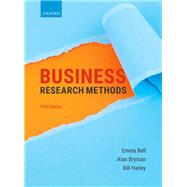
BUSINESS RESEARCH METHODS 5E
by Bell, Emma; Bryman, Alan; Harley, BillEdition: 5th
Format: Paperback
Pub. Date: 2019-02-06
Publisher(s): Oxford University Press
-

This Item Qualifies for Free Shipping!*
*Excludes marketplace orders.
List Price: $134.39
Rent Textbook
Select for Price
New Textbook
We're Sorry
Sold Out
Used Textbook
We're Sorry
Sold Out
eTextbook
We're Sorry
Not Available
How Marketplace Works:
- This item is offered by an independent seller and not shipped from our warehouse
- Item details like edition and cover design may differ from our description; see seller's comments before ordering.
- Sellers much confirm and ship within two business days; otherwise, the order will be cancelled and refunded.
- Marketplace purchases cannot be returned to eCampus.com. Contact the seller directly for inquiries; if no response within two days, contact customer service.
- Additional shipping costs apply to Marketplace purchases. Review shipping costs at checkout.
Summary
Author Biography
Emma Bell is Professor of Organisation Studies at the Open University, UK. She has an enduring interest in methods and methodological issues and has published widely in this area. Emma is a past Co-Chair of the Critical Management Studies Division of the Academy of Management, current joint Vice-Chair of Research and Publications, British Academy of Management, and joint Editor-in-Chief of Management Learning.
The late Alan Bryman was Professor of Organizational and Social Research at the University of Leicester from 2005 to 2017. Prior to this, he was Professor of Social Research at Loughborough University for thirty-one years. His main research interests were in leadership, especially in higher education, research methods (particularly mixed methods research), and the 'Disneyization' and 'McDonaldization' of modern society. Alan was also the author of the bestselling textbook Social Research Methods (Oxford University Press, 2015) as well as contributing to a range of leading journals.
Bill Harley is Professor of Management in the Department of Management and Marketing at The University of Melbourne. Bill's academic research has been motivated by an abiding interest in the centrality of work to human life. His work has been published in journals including the British Journal of Industrial Relations, Journal of Management Studies, Industrial Relations, and Work Employment and Society. Bill was previously General Editor of Journal of Management Studies and is currently on the editorial boards of the same journal, as well as Academy of Management Learning and Education and Human Relations.
Table of Contents
Part 1: The Research Process
1: The Nature and Process of Business Research
2: Business Research Strategies
3: Research Designs
4: Planning a Research Project and Developing Research Questions
5: Getting Started: Reviewing the Literature
6: Ethics in Business Research
7: Writing Up Business Research
Part 2: Quantitative Research
8: The Nature of Quantitative Research
9: Sampling In Quantitative Research
10: Structured Interviewing
11: Self-Completion Questionnaires
12: Asking Questions
13: Quantitative Research Using Naturally Occurring Data
14: Secondary Analysis and Official Statistics
15: Quantitative Data Analysis
16: Using IBM SPSS Statistics
Part 3: Qualitative Research
17: The Nature of Qualitative Research
18: Sampling In Qualitative Research
19: Ethnography and Participant Observation
20: Interviewing In Qualitative Research
21: Focus Groups
22: Language in Qualitative Research
23: Documents as Sources of Data
24: Qualitative Data Analysis
25: Computer-Assisted Qualitative Data Analysis: Using Nvivo
Part 4: Mixed Methods Research
26: Breaking down The Quantitative/Qualitative Divide
27: Mixed Methods Research: Combining Quantitative and Qualitative Research
Part 1: The research process
1. The nature and process of business research
2. Business research strategies
3. Research designs
4. Planning a research project and developing research questions
5. Getting started: reviewing the literature
6. Ethics in business research
7. Writing up business research
Part 2: Quantitative research
8. The nature of quantitative research
9. Sampling in quantitative research
10. Structured interviewing
11. Self-completion questionnaires
12. Asking questions
13. Quantitative research using naturally occurring data: structured observation and content analysis
14. Secondary analysis and official statistics
15. Quantitative data analysis
16. Using IBM SPSS statistics
Part 3: Qualitative research
17. The nature of qualitative research
18. Sampling in qualitative research
19. Ethnography and participant observation
20. Interviewing in qualitative research
21. Focus groups
22. Language in qualitative research
23. Documents as sources of data
24. Qualitative data analysis
25. Computer-assisted qualitative data analysis: using NVivo
Part 4: Mixed methods research
26. Breaking down the quantitative/qualitative divide
27. Mixed methods research: combining quantitative and qualitative research
An electronic version of this book is available through VitalSource.
This book is viewable on PC, Mac, iPhone, iPad, iPod Touch, and most smartphones.
By purchasing, you will be able to view this book online, as well as download it, for the chosen number of days.
Digital License
You are licensing a digital product for a set duration. Durations are set forth in the product description, with "Lifetime" typically meaning five (5) years of online access and permanent download to a supported device. All licenses are non-transferable.
More details can be found here.
A downloadable version of this book is available through the eCampus Reader or compatible Adobe readers.
Applications are available on iOS, Android, PC, Mac, and Windows Mobile platforms.
Please view the compatibility matrix prior to purchase.