
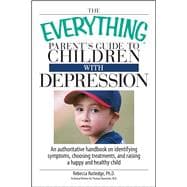
The Everything Parent's Guide to Children With Depression
by Rutledge, Rebecca,Format: Paperback
Pub. Date: 2007-06-01
Publisher(s): Everything
 Other versions by this Author
-

This Item Qualifies for Free Shipping!*
*Excludes marketplace orders.

List Price: $20.99
Rent Book
Select for Price
New Book
We're Sorry
Sold Out
Used Book
We're Sorry
Sold Out
eBook
We're Sorry
Not Available
How Marketplace Works:
- This item is offered by an independent seller and not shipped from our warehouse
- Item details like edition and cover design may differ from our description; see seller's comments before ordering.
- Sellers much confirm and ship within two business days; otherwise, the order will be cancelled and refunded.
- Marketplace purchases cannot be returned to eCampus.com. Contact the seller directly for inquiries; if no response within two days, contact customer service.
- Additional shipping costs apply to Marketplace purchases. Review shipping costs at checkout.
Summary
Does your child seem sad, withdrawn, or lethargic? You know something's wrong, but you're not sure what to do about it. You're not alone-some six million children suffer from depression. Your child needs help-your help. With The Everything[Registered] Parent's Guide to Children with Depression, you can ensure that your child receives the right support and treatment. In this reassuring, practical handbook, Drs. Rebecca Rutledge and Thomas Bannister offer the professional advice you need to determine: If your child is at risk, How and when to get professional help, The best treatment options, Benefits and side effects of medication, What you and your family can do to help. Rutledge, an expert psychologist, and Bannister, a clinical psychiatrist, are both known for their work with depressed children and adolescents. With their help, you'll understand why your child is unhappy-and what you can do about it. Book jacket.
Author Biography
An Adams Media author.
Table of Contents
| Introduction | p. xiii |
| Getting a Handle on Childhood Depression | p. 1 |
| Do Kids Really Get Depressed? | p. 1 |
| Prevalence in Children and Teens | p. 3 |
| Theories of Depression | p. 5 |
| What Is Depression Exactly? | p. 11 |
| Childhood Versus Teenage Depression | p. 13 |
| Behavioral Symptoms | p. 14 |
| Emotional Symptoms | p. 16 |
| Causes of Depression | p. 19 |
| Genetics | p. 19 |
| Brain Chemistry | p. 20 |
| Physical Illness | p. 21 |
| The Family Environment | p. 23 |
| Loss | p. 24 |
| Television and Other Influences | p. 27 |
| Stressful Life Events | p. 28 |
| Predictors of Depression | p. 33 |
| Family History | p. 33 |
| Loss | p. 37 |
| Sleep and Appetite | p. 38 |
| Behavior | p. 41 |
| Comments | p. 43 |
| Helplessness | p. 44 |
| Self-esteem | p. 45 |
| Is My Child Depressed? | p. 49 |
| A Look at the Depressed Child | p. 49 |
| Keep a Calendar | p. 53 |
| Glean Information from School, Family, and Friends | p. 55 |
| Get the Diagnosis Right | p. 57 |
| Using Depression Questionnaires | p. 59 |
| Psychotic Depression | p. 61 |
| Get a Physical Exam | p. 63 |
| Risk Factors | p. 65 |
| Problems with Social Skills | p. 65 |
| School Problems | p. 68 |
| Learning Disabilities | p. 70 |
| Chronic Illness | p. 71 |
| Family Environment | p. 73 |
| Sibling Troubles | p. 77 |
| Preexisting Psychiatric Illness | p. 79 |
| Depression as a Part of Other Psychological Problems | p. 81 |
| Anxiety Disorders | p. 81 |
| Eating Disorders | p. 88 |
| Sexuality | p. 89 |
| Self-injury | p. 89 |
| Learning Disorders | p. 90 |
| Behavioral Problems | p. 91 |
| Low Self-esteem | p. 92 |
| Dysthymia and Bipolar Disorder | p. 93 |
| Defining and Diagnosing Dysthymia | p. 93 |
| What Does a Dysthymic Child Look Like? | p. 95 |
| Where Dysthymia Ends and Depression Begins | p. 96 |
| Defining and Diagnosing Bipolar Disorder | p. 97 |
| What Does a Bipolar Child Look Like? | p. 100 |
| Track the Symptoms | p. 102 |
| Treatment Options | p. 102 |
| Depression-related Issues | p. 107 |
| Depression's Link to Other Mental Illnesses | p. 107 |
| Attention Deficit Hyperactivity Disorder | p. 108 |
| Oppositional Defiant Disorder | p. 110 |
| Conduct Disorder | p. 111 |
| Physical and Sexual Abuse | p. 113 |
| Seasonal Affective Disorder | p. 113 |
| Alcohol and Drug Abuse | p. 114 |
| Posttraumatic Stress Disorder | p. 117 |
| Medical Illness | p. 120 |
| Seeking Professional Help | p. 121 |
| When to Intervene | p. 121 |
| Parental Reservations about Getting Help | p. 122 |
| Educating Yourself | p. 123 |
| Finding a Diagnostician | p. 129 |
| Preparing for the First Appointment | p. 130 |
| How to Pick the Right Therapist | p. 131 |
| The Importance of Honesty and Full Disclosure | p. 134 |
| The Decision to Undergo Treatment | p. 135 |
| Do Your Homework | p. 135 |
| Discussing Treatment with Your Child | p. 137 |
| Who Else Needs to Know? | p. 139 |
| Exploring Parental Feelings and Fears | p. 140 |
| Trust Your Gut | p. 144 |
| Getting a Second Opinion | p. 144 |
| Treatment for the Mind, Body, and Soul | p. 147 |
| Psychotherapy | p. 147 |
| Medication | p. 152 |
| Medication Side Effects | p. 155 |
| Alternative Remedies | p. 157 |
| Diet, Exercise, and Spirituality | p. 158 |
| The Role of Advocate for Your Child | p. 159 |
| Strategies for Children | p. 161 |
| Education | p. 161 |
| Cognitive Restructuring | p. 163 |
| Problem-Solving Skills | p. 168 |
| Communication Skills | p. 170 |
| Labeling Emotions | p. 171 |
| Seeking Outlets for Emotional Expression | p. 172 |
| Demystifying the Stigma of Mental Illness | p. 174 |
| Suicide: Is Your Child at Risk? | p. 175 |
| Prevalence among Children and Teens | p. 175 |
| Risk Factors | p. 176 |
| Warning Signs | p. 181 |
| Suicidal Ideation | p. 185 |
| Suicide-proofing the Home | p. 186 |
| Help Manage Suicidal Thoughts, Feelings, and Behaviors | p. 188 |
| Inpatient Treatment | p. 191 |
| Is It Time for Inpatient Treatment? | p. 191 |
| Treatment Settings | p. 194 |
| Picking a Facility | p. 197 |
| What to Expect from Inpatient Treatment | p. 200 |
| The Parental Role in Treatment | p. 203 |
| Inpatient Treatment Is Over-Now What? | p. 204 |
| Prevention | p. 207 |
| Open Communication | p. 207 |
| Teaching Communication Skills | p. 209 |
| Physical Activity | p. 211 |
| Creative Outlets | p. 212 |
| Education | p. 213 |
| Fostering Self-esteem | p. 215 |
| All in the Family | p. 219 |
| Depression's Effect on the Family | p. 219 |
| Caring for the Caregiver | p. 222 |
| Nurture the Adult Relationship | p. 225 |
| Siblings | p. 228 |
| Extended Family | p. 230 |
| Family Therapy | p. 232 |
| Parenting the Depressed Child | p. 235 |
| Avoiding the "Poor, Pitiful Me" Syndrome | p. 235 |
| Developing Trust | p. 238 |
| Effective Discipline | p. 240 |
| Knowing When to Back Off | p. 244 |
| Keep Perspective in the Midst of Chaos | p. 245 |
| Encourage Self-reliance | p. 247 |
| At-risk Parents and Depression | p. 249 |
| Depression | p. 249 |
| Drug and Alcohol Abuse | p. 252 |
| Divorce | p. 254 |
| Marital Discord | p. 256 |
| Parental History of Abuse | p. 257 |
| Toxic Parenting | p. 258 |
| School | p. 265 |
| Should the School Know? | p. 265 |
| Reasonable Accommodations | p. 268 |
| Putting School Resources to Good Use | p. 270 |
| The Parent's Role at School | p. 272 |
| Manage Depression's Effect on School Performance | p. 274 |
| When the School Isn't on Board | p. 278 |
| What Does the Future Hold? | p. 281 |
| Is the Depression Gone? | p. 281 |
| Overparenting | p. 283 |
| Maintain a Close Relationship | p. 285 |
| Prepare for Developmental Changes | p. 287 |
| Your Child's Identity after Depression | p. 292 |
| Major Life Events and Stressors | p. 293 |
| Conclusion | p. 294 |
| Resources on Childhood and Adolescent Depression | p. 295 |
| Depression Questionnaires | p. 297 |
| Index | p. 299 |
| Table of Contents provided by Ingram. All Rights Reserved. |
An electronic version of this book is available through VitalSource.
This book is viewable on PC, Mac, iPhone, iPad, iPod Touch, and most smartphones.
By purchasing, you will be able to view this book online, as well as download it, for the chosen number of days.
Digital License
You are licensing a digital product for a set duration. Durations are set forth in the product description, with "Lifetime" typically meaning five (5) years of online access and permanent download to a supported device. All licenses are non-transferable.
More details can be found here.
A downloadable version of this book is available through the eCampus Reader or compatible Adobe readers.
Applications are available on iOS, Android, PC, Mac, and Windows Mobile platforms.
Please view the compatibility matrix prior to purchase.