
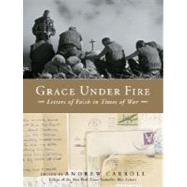
Grace Under Fire
by CARROLL, ANDREWFormat: Hardcover
Pub. Date: 2007-03-06
Publisher(s): Doubleday Religion
 Other versions by this Author
-

This Item Qualifies for Free Shipping!*
*Excludes marketplace orders.

List Price: $17.80
Rent Book
Select for Price
New Book
We're Sorry
Sold Out
Used Book
We're Sorry
Sold Out
eBook
We're Sorry
Not Available
How Marketplace Works:
- This item is offered by an independent seller and not shipped from our warehouse
- Item details like edition and cover design may differ from our description; see seller's comments before ordering.
- Sellers much confirm and ship within two business days; otherwise, the order will be cancelled and refunded.
- Marketplace purchases cannot be returned to eCampus.com. Contact the seller directly for inquiries; if no response within two days, contact customer service.
- Additional shipping costs apply to Marketplace purchases. Review shipping costs at checkout.
Summary
Words of wisdom, hope, humor, and strength from those who have been tested by fire and maintained their faith. The first book of its kind,Grace Under Fireis an inspiring and spiritual collection of letters and e-mails by U.S. troops and their families from the American Revolution through the War on Terrorism. Andrew Carroll, editor of the bestsellingWar Letters, went through his massive archive of seventy-five-thousand previously unpublished wartime correspondence to pick out the most intimate, dramatic, historic, and insightful letters and e-mails ever written about God, religion, and spirituality. The fifty best of these are featured in this incredible book, and they emphasize how extremely important faith has been, and continues to be, in the lives of U.S. troops and their families. What is especially remarkable aboutGrace Under Fireis the sheer diversity of the collection, which includes several extraordinary letters by two brothers who fought on opposing sides of the Civil War; a prophetic letter by Rabbi David Goode, one of the famed Immortal Chaplains who gave his life for his fellow soldiers; a lighthearted letter by a World War II nurse who met the Pope; and a profound and impassioned reply to the timeless question, "Where is God in wartime?" by a doctor serving in Iraq. Warfare can reveal the worst in human nature, but it can also bring out the best, and these correspondences are a testament to the heroism, compassion, grace, intelligence, and inherent goodness of American troops and their families. And although the letters and e-mails featured in this book were written in times of armed conflict, they transcend the subject of war. They are about determination, hope, patriotism, fighting for something greater than one's self, and, of course, the enduring value of faith. Regardless of whether we have served in the military or not, we can all find inspiration and courage in these powerful and insightful words.
Author Biography
ANDREW CARROLL is the founder of the Legacy Project and the editor of several New York Times bestselling collections of letters, including Letters of a Nation and War Letters, as well as the critically acclaimed Behind the Lines. War Letters was the inspiration for the PBS documentary of the same name, which was produced by American Experience.
Excerpts
The American Revolution James Williams, Serving in the War of Independence, Tells His Son Daniel That He Is Off Fighting in Defense of Their "Rights and Liberties" Few letters by U.S. troops who fought in the American Revolution exist today. Compared to other major conflicts in our nation's history, not as many letters were written; there was no postal system to speak of, paper was scarce, and a significant number of soldiers were illiterate. Unfortunately, of the letters that were sent from the front lines (and they were usually hand-delivered through an informal network), many were lost or damaged over time. But what is remarkable about the relatively small number of letters that have survived is how similar the sentiments are to those expressed in correspondence written today. The language is much more formal, but the emotions are very much the same. On June 12, 1779, thirtyeightyearold James Williams of Hanover, Virginia, penned the following letter to his son Daniel, explaining to him that he is now the man of the house and to place his trust in God. Dear Son: This is the first chance I have had to write you. I am, by the cause of Providence, in the field in defence of my country. When I reflect on the matter, I feel myself distracted on both hands by this thought, that in my old age I should be obliged to take the field in defence of my rights and liberties, and that of my children. God only knows that it is not of choice, but of necessity, and from the consideration that I had rather suffer anything than lose my birthright, and that of my children. When I come to lay down in the field, stripped of all the pleasure that my family connections afford me at homesurrounded by an affectionate wife and eight dear children, and all the blessings of lifewhen I reflect on my own distress, I feel for that of my family, on account of my absence from their midst; and especially for the mother, who sits like a dove that has lost its mate, having the weight of the family on her shoulders. These thoughts make me afraid that the son we so carefully nursed in our youth may do something that would grieve his mother. Now, my son, if my favor is worth seeking, let me tell you the only step to procure it is the care of your tender motherto please her is ten times more valuable than any other favor that you could do me in my person. I am sorry to have to inform you of the melancholy death of Anthony Griffin, which took place on the 11th instant, while out with a scouting party. Alighting from his horse, and leaning on his gun, it accidentally went off, shooting him through the head. He never spoke after the accident. This is a fatal consequence of handling guns without proper care; they ought to be used with the greatest caution. The uncertainty of life ought to induce every man to prepare for death. Now, my son, I must bid you farewell. I commit you to the care of Providence, begging that you will try to obtain that peculiar blessing. May God bless you, my son, and give you grace to conduct yourself, in my absence, as becomes a dutiful son to a tender mother and the family. I am in reasonable good health at present, and the regiment as much so as could be expected. The death of Griffin is much lamented. I hope in God this will find you, my son, and your dear mother and the children, all well. My best compliments to you all, and all enquiring friends. I am, dear son, with great respect, your affectionate father, Jas. Williams The Civil War Before Facing His Brother Percival in Battle During the Civil War, Thomas Drayton Castigates Him for turning Against His Native Landand God & Percival Drayton Writes to a Cousin About the South's "Unholy Rebellion"
An electronic version of this book is available through VitalSource.
This book is viewable on PC, Mac, iPhone, iPad, iPod Touch, and most smartphones.
By purchasing, you will be able to view this book online, as well as download it, for the chosen number of days.
Digital License
You are licensing a digital product for a set duration. Durations are set forth in the product description, with "Lifetime" typically meaning five (5) years of online access and permanent download to a supported device. All licenses are non-transferable.
More details can be found here.
A downloadable version of this book is available through the eCampus Reader or compatible Adobe readers.
Applications are available on iOS, Android, PC, Mac, and Windows Mobile platforms.
Please view the compatibility matrix prior to purchase.