
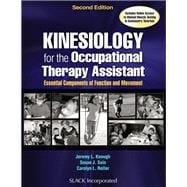
Kinesiology for the Occupational Therapy Assistant Essential Components of Function and Movement

by ; ;
Edition: 2nd
Format: Workbook
Pub. Date: 2017-08-15
Publisher(s): Slack Incorporated
  • Free Shipping Icon

    This Item Qualifies for Free Shipping!*

    *Excludes marketplace orders.

List Price: $90.25

Rent Textbook

Select for Price
There was a problem. Please try again later.

New Textbook

We're Sorry
Sold Out

Used Textbook

We're Sorry
Sold Out

eTextbook

We're Sorry
Not Available

How Marketplace Works:

  • This item is offered by an independent seller and not shipped from our warehouse
  • Item details like edition and cover design may differ from our description; see seller's comments before ordering.
  • Sellers much confirm and ship within two business days; otherwise, the order will be cancelled and refunded.
  • Marketplace purchases cannot be returned to eCampus.com. Contact the seller directly for inquiries; if no response within two days, contact customer service.
  • Additional shipping costs apply to Marketplace purchases. Review shipping costs at checkout.

Summary

Kinesiology for the Occupational Therapy Assistant: Essential Components of Function and Movement, Second Edition approaches the study of kinesiology by connecting function to the underlying components that make movement possible. Jeremy Keough, Susan Sain, and Carolyn Roller present a text that makes learning and retaining information easier for students through application.

A top-down approach, based on the AOTA’s Occupational Therapy Practice Framework, Third Edition is used to allow the student to see the big picture and then guides them to understand what fundamental kinesiological functions may be causing limitations or decreased engagement in daily activities.

Benefits and Features:
  • New chapters on kinesiology and therapeutic exercise, as well as functional mobility in the home and community
  • Upper extremity information is divided into four chapters for enhanced learning; information presented addresses function across the lifespan
  • Occupational profiles describing actual client conditions at the beginning of several chapters
  • Occupation/real-life based activities and questions at the end of each chapter
  • Emphasis on function and identification of how and why movement occurs
  • Multiple tables and figures to enhance learning
  • Call out boxes that highlight and clarify key concepts
  • A seamless integration of theory, fact, and practice
  • Selected standardized tests, pinch and grip strength, and range of motion norms
  • Glossary of terms and expanded Web resources
  • Instructors materials include PowerPoint presentations, student study guides, and a test bank
Bonus!
You will receive access to Goniometry and Manual Muscle Testing interactive learning tutorials FREE for 120 days with your new text purchase of Kinesiology for the Occupational Therapy Assistant, Second Edition. Watch the videos, read the text, listen to the experts explain the techniques—all at your own pace.

Kinesiology for the Occupational Therapy Assistant: Essential Components of Function and Movement, Second Edition provides students with thorough explanations and learning activities that will put kinesiology into context. Students will also gain insight into the practice of occupational therapy through directed questions and problem solving to assist the client in achieving movement goals.


Author Biography

Jeremy L. Keough, MSOT, OTR/L, FAOTA, is currently a staff occupational therapist at Blount Memorial Hospital in Maryville, Tennessee. Jeremy earned his undergraduate degree in Occupational Therapy from Eastern Kentucky University and a post-professional master’s degree from Belmont University. His professional experiences include long-term care, inpatient rehabilitation, outpatient rehabilitation, work hardening, acute care, and occupational therapy assistant education. Jeremy has served as the Occupational Therapy Assistant Program Director at Roane State Community College, during which he instructed the kinesiology course. Currently, Jeremy’s interests include neurorehabilitation approaches, dementia care, functional movement, and volunteering for youth baseball programs and community veterans organizations.
 
Susan J. Sain, MS, OTR/L, FAOTA, is currently a faculty member and academic fieldwork coordinator at Roane State Community College in Tennessee. Susan earned her undergraduate degree in Occupational Therapy from the University of Wisconsin at Madison along with a degree in Spanish. She later earned a master’s degree in Health Promotion/Health Education from the University of Tennessee at Knoxville. Her professional experiences include adult and child psychology, skilled nursing, pediatrics in a variety of settings, early intervention, and academia. Susan served as the program director of the occupational therapy assistant program at Roane State Community College for 11 years and has been the academic fieldwork coordinator for 9 years. Susan has instructed the kinesiology course for more than 17 years. Susan has served in a variety of volunteer positions for state associations, including the American Occupational Therapy Association and the National Board for Certification in Occupational Therapy. Her current interests include aging in place, environmental psychology, and universal design.
 
Carolyn L. Roller, OTR/L, is an adjunct faculty member in the Occupational Therapy Assistant program at Roane State Community College in Oak Ridge, Tennessee. She also works pro re nata (PRN) as a hand therapist in several clinics in the Knoxville, Tennessee area. Carolyn earned her undergraduate degree in Occupational Therapy from the University of Wisconsin at Milwaukee. Her professional experiences include outpatient rehabilitation, home and job site analysis, ergonomic considerations in the wellness community, and occupational therapy assistant education. Carolyn was an adjunct faculty member at South College in Knoxville, Tennessee, teaching kinesiology in the occupational therapy assistant program and prevention of hand injuries in the wellness community.
 

Table of Contents

Acknowledgments

About the Authors

Contributing Authors

Introduction

Unique Features of This Kinesiology Text

Chapter 1        Kinesiology: A Foundation in Occupational Therapy

                       Jeremy L. Keough, MSOT, OTR/L, FAOTA and Susan J. Sain, MS, OTR/L, FAOTA

Chapter 2        Human Body Functions and Structures Influencing Movement

                        Susan J. Sain, MS, OTR/L, FAOTA

Chapter 3        Factors Influencing Movement

                       Susan J. Sain, MS, OTR/L, FAOTA

Chapter 4        Introducing Body Movement

                        Jeremy L. Keough, MSOT, OTR/L, FAOTA

Chapter 5        Function and Movement of the Trunk and Neck

                        Maribeth P. Vowell, PT, MPH, EdD

Chapter 6        The Essential Functions of the Lower Extremity

                        Maribeth P. Vowell, PT, MPH, EdD

Chapter 7        Function and Movement of the Shoulder and Scapula

                        Carolyn L. Roller, OTR/L

Chapter 8        Function and Movement of the Elbow Complex

                       Carolyn L. Roller, OTR/L

Chapter 9        Function and Movement of the Wrist and Extrinsic Hand

                        Carolyn L. Roller, OTR/L

Chapter 10      Function and Movement of the Intrinsic Hand

                        Carolyn L. Roller, OTR/L

Chapter 11      Kinesiology and Therapeutic Exercise

                        Matthew J. Sabin, PhD, ATC, LAT

Chapter 12      Functional Mobility in the Home and Community

                        Dana M. Howell, PhD, OTD, OTR/L, FAOTA

Glossary

Appendix A: Web Resources

Appendix B: Available Range of Motion Norms

Appendix C: Epilogue of Occupational Profiles

Appendix D: Grip/Pinch and Testing Norms

Financial Disclosures

Index

An electronic version of this book is available through VitalSource.

This book is viewable on PC, Mac, iPhone, iPad, iPod Touch, and most smartphones.

By purchasing, you will be able to view this book online, as well as download it, for the chosen number of days.

Digital License

You are licensing a digital product for a set duration. Durations are set forth in the product description, with "Lifetime" typically meaning five (5) years of online access and permanent download to a supported device. All licenses are non-transferable.

More details can be found here.

A downloadable version of this book is available through the eCampus Reader or compatible Adobe readers.

Applications are available on iOS, Android, PC, Mac, and Windows Mobile platforms.

Please view the compatibility matrix prior to purchase.