
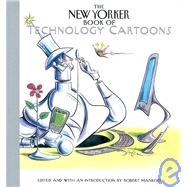
The New Yorker Book of Technology Cartoons
by Mankoff, RobertFormat: Hardcover
Pub. Date: 2000-10-01
Publisher(s): John Wiley & Sons Inc
 Other versions by this Author
-

This Item Qualifies for Free Shipping!*
*Excludes marketplace orders.

List Price: $26.20
Rent Book
Select for Price
New Book
We're Sorry
Sold Out
Used Book
We're Sorry
Sold Out
eBook
We're Sorry
Not Available
How Marketplace Works:
- This item is offered by an independent seller and not shipped from our warehouse
- Item details like edition and cover design may differ from our description; see seller's comments before ordering.
- Sellers much confirm and ship within two business days; otherwise, the order will be cancelled and refunded.
- Marketplace purchases cannot be returned to eCampus.com. Contact the seller directly for inquiries; if no response within two days, contact customer service.
- Additional shipping costs apply to Marketplace purchases. Review shipping costs at checkout.
Summary
Technology-friend or foe? That's a question the brilliant cartoonists of The New Yorker have been pondering with no little skepticism-and answering hilariously-for decades. This is not because of a fascination with technology itself, but because technology has, more and more, inserted itself into our everyday lives-in ways delightful to some and surreal to others. Whichever way you feel at any given moment, these cartoons help you laugh at technology toys, trends, trials, and tribulations. Robert Mankoff, the cartoon editor of The New Yorker, who has a self-proclaimed love-hate relationship with technology, assembled a one-of-a-kind introduction (to say wrote wouldn't do it full justice) and selected 110 of the best cartoons ever done on technology and its effects on us all. And as a special bonus, the enclosed CD-ROM includes all the cartoons in the book, ready to be sent easily as e-mail attachments.
Table of Contents
INDEX OF ARTISTS Marisa Acocella Charles Addams Charles Barsotti George Booth John Caldwell Roz Chast Tom Cheney Richard Cline Frank Cotham Michael Crawford Leo Cullum J.C. Duffy Ed Fisher Mort Gerberg Alex Gregory Sam Gross William Haefeli William Hamilton J.B. Handelsman Sidney Harris Bruce Eric Kaplan Edward Koren Arnie Levin Lee Lorenz Robert Mankoff Michael Maslin Warren Miller John O'Brien Donald Reilly Mischa Richter Victoria Roberts Al Ross Bernard Schoenbaum Danny Shanahan David Sipress Barbara Smaller Peter Steiner Mick Stevens James Stevenson Mike Twohy P.C. Vey Dean Vietor Robert Weber Gahan Wilson Jack Ziegler
Excerpts
Introduction
BY ROBERT MANKOFF
Welcome to the Introduction
to'The New Yorker Book of
Technology Cartoons'
Please press any key to continue.
ALERT! Error Code 006#!%!!--No Key Pressed--Human Error--You. That's right, you. We know all about you. Our sophisticated tracking technology has been sending us your data ever since you purchased this book. And everything seemed OK until you refused to press that key. Now it appears you have an antitechnological tendency that has to be dealt with. My advice: get over it, move on--technology already has.
The essence of technology is change. In fact, the world of technology changes so fast that by the time you finish this introduction the first part of it will already be obsolete. Fortunately, an upgrade is already available and can be downloaded at www.bythetimeyoufinishthisintroductionthefirstpartofitwillbeobsolete.com or at its mirror site: moc.etelosboeblliwtifotraptsrifehtnoitcudortnisihthsinifuoyemitehtyb.www
If downloading the upgrade fails, upgrading your download software may be required. However; if that exceeds the meager bandwidth of your wetware, versions of the introduction's upgrade are also available offline at fine NotDot-Com stores everywhere in CD, DVD, and the increasingly popular BVD formats (S, M, L, or XL).
As you may have guessed by now, I'm a technophile. Look, it could be worse. I could be a Francophile. Actually, it's more complicated than that; I have a love-hate relationship with technology--I love it when it works, and I hate it when it doesn't. But even when the technology works, I often find myself resenting it. Like when my communications center tells me I have no voice mail, no pager messages, no e-mail, and no friends. Or when my Global Positioning System, which is constantly tracking my exact spot on Earth to within fifty feet, suggests that really, I should get out more. Or when my computer cannot find a chess level low enough to play with me and recommends a "smart" appliance as a suitable opponent. (Or when the appliance wins.) At moments like these I find myself quickly changing from a mild-mannered technophile to a wild-mannered technopath.
But these technocidal impulses never hold sway for long. And before you can say "dot-com," I'm plunging ever deeper into a world where Murphy's Law combines with Moore's Law to insure that everything that can go wrong will go wrong, but at twice the rate that it did eighteen months ago. Example: I've got a new electronic organizer clipped right on the back of my cell phone. And the phone has been tweaked to function as a wireless modem for my laptop, which can now transfer e-mails back to my organizer, which, of course, causes it to run out of memory. Now, I could get more memory for the organizer, or I could wait for the next product cycle to spawn an updated version that could handle the increased message load. This new organizer would undoubtedly require me to replace all the other equipment in my high-tech scheme, but frankly, it's about time I got rid of all that old junk anyway.
The absurdity of all this is not lost on me. As soon as I put my e-check in the e-mail for the latest e-thing I'm thinking, "Egad! I've become desperately dependent on an army of devices that I don't need." It makes me wonder: if, as all the information-age pundits tell me, technology is my servant, how come I've become its slave?
I'd like to place the blame for all this on the new economy, the new media, the new paradigm, or that new e-thing I just bought, but the real culprit is just plain old me, as this fifteen-year-old, very autobiographical New Yorker cartoon of mine attests.
Basically, I never met a consumer technology I didn't like. You build it, and I'll buy it. Why? Well, if this pocket genome decoder of mine is correct, it's because I'm hardwired for it.
Other cartoonists are wired a bit differently. The ones in this book represent a continuum with me over at one end (some would say the deep end) while on the other end are guys like Charlie Barsotti and Jack Ziegler, who view any technology later than that of the technical pen with suspicion. Although they use computers and their ilk, their attitude, as expressed in the self-portraits done for this introduction, is that the computers are using them .
But if Ziegler and Barsotti think that a cartoonist needs cutting-edge technology as much as a fish needs a bicycle, Tom (Borg) Cheney clearly envisions a day when a bioengineered flounder wins the Tour de France.
Other self-portraits, like those of Mick Stevens and Marisa Acocella, evince a vague sense of foreboding, bringing to mind Yeats's prophetic quote from The Second Coming , "Turning and turning in the widening gyre / The falcon cannot hear the falconer; / Nor can he page him." Acocella's drawing further suggests the question "If this is the information age, how come we can't retain any?"
In fact, I happen to know the answer to that question. Or at least I know the database the answer is stored in. Now, if only I could remember the password. Clearly, we have become dependent on technology. We can't live without it. How it feels about us, however, is another matter addressed by the one cartoonist I know who actually draws his cartoons on a computer.
Gregory may be right. Time is running out for cartoons done by humans, or even looked at by humans. But don't despair, the carbon-based life-form is still in the driver's seat, even though--as Frank Cotharn's portrait shows--it's getting a little crowded up there.
Meanwhile, my advice is to enjoy the ride, no matter how bumpy. The jokes are on us, about us, and for us, and all you have to do to access 110 of them is to press any key below.
On second thought, just turn the page.
Copyright © 2000 The New Yorker Collection. All rights reserved.
An electronic version of this book is available through VitalSource.
This book is viewable on PC, Mac, iPhone, iPad, iPod Touch, and most smartphones.
By purchasing, you will be able to view this book online, as well as download it, for the chosen number of days.
Digital License
You are licensing a digital product for a set duration. Durations are set forth in the product description, with "Lifetime" typically meaning five (5) years of online access and permanent download to a supported device. All licenses are non-transferable.
More details can be found here.
A downloadable version of this book is available through the eCampus Reader or compatible Adobe readers.
Applications are available on iOS, Android, PC, Mac, and Windows Mobile platforms.
Please view the compatibility matrix prior to purchase.